
🔴 TECHNICAL LIVESTREAM • LIVE ON YOUTUBE
Date & Time: Saturday, Nov 7, 2026 • 11:00 Almaty
Format: 20-min Technical discussion + 10-min Open Q&A
From Paper to Production API
Get the private YouTube / Zoom link, calendar invite, and post-event technical summaries.
Who Should Attend?
🎓 Master’s & PhD Students
Learn how to frame thesis research into runnable code artifacts, find co-supervisors, and attract commercial venture backing for your dissertation.
🚀 Startups & Founders
Discover how to bring university scientists on board as Chief Scientist advisors and solve deep mathematical / AI bottlenecks without reinventing wheels.
🛠️ Builders & Engineers
See the step-by-step pipeline of wrapping complex PyTorch models into Dockerized FastAPI microservices with unit tests and benchmark datasets.
Agenda & Technical Takeaways
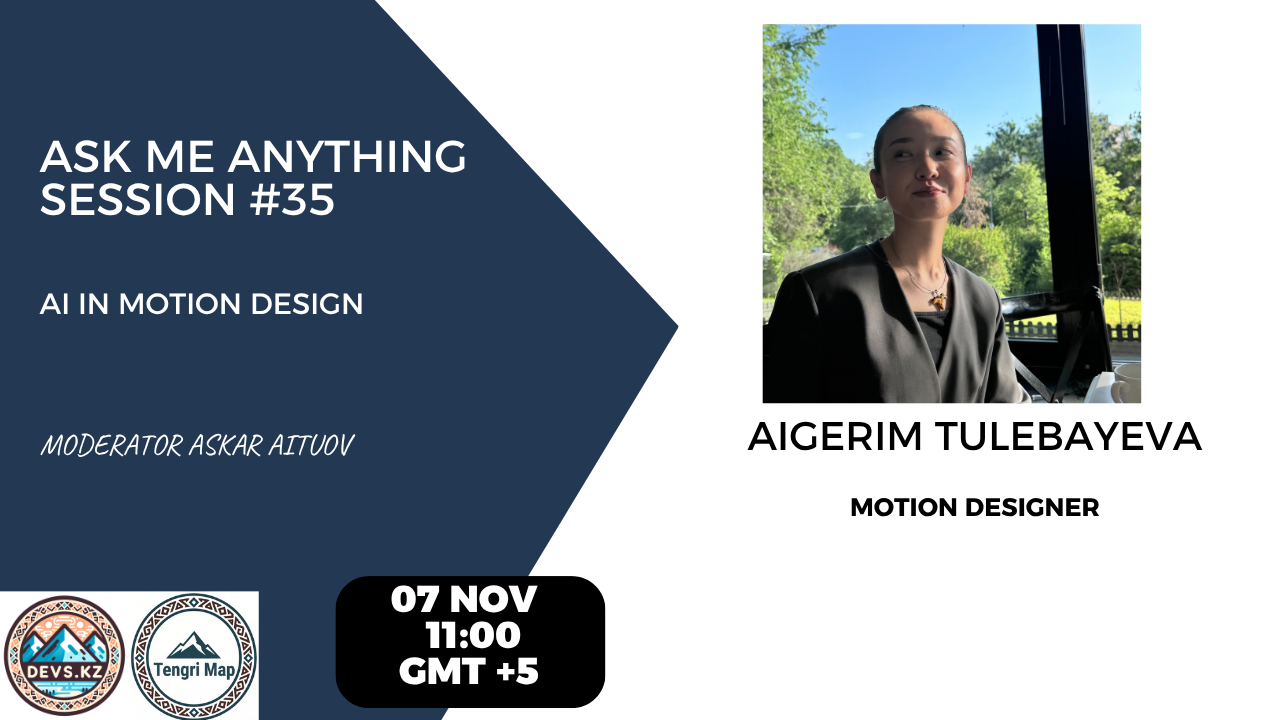
With Aigerim Tulebayeva we will discuss AI practices for motion design. Aigerim has experience in 2D/3D animation, LED visuals and Architecturel projection mapping. She worked with COCA-COLA, VISA, BCC, HALYK QALAM, JTI (PLOOM), KAIZEN, WHO EUROPE Aigerim’s profiles:
https://www.instagram.com/aiger.on/
Featured Speakers
Aigerim Tulebayeva — Motion designer
Askar Aituov — Editor at Tengrimap.com and Devs.kz.
Transcript.
Host – Askar Aituov: Hi all. Apologies for being late. It’s a technical difficulty on my side. We have Aigerim Tulebayeva, she is an expert in motion design, and today we will discuss AI in motion design. Aigerim, thank you for your time. Apologies again for the delay, and could you please tell a few words about your background?
Aigerim: Tulebayeva (motion designer) Hi everyone. I’m a motion designer with experience in 2D and 3D motion design. I started as a graphic designer, which means in my early career I did more static pictures. Then I figured out that what you have done in static, you can animate it and give it some flow, motion. Then I started as a graphic designer, then I figured out such softs as Adobe After Effects—it’s my core soft where I do all the job. Yes, I think that’s it.
Host: You have a great background working in different companies. I’m sure some people will be asking questions later. So let’s go to questions. Guys, if you have questions, you can feel free to type directly in the chat, or if you watch the recording, you can ask questions in the comments and we will deliver it to Aigerim. So, how AI tools like Runway and Sora change your workflow? Do they save time, and how do they help you if they do?
Aigerim: Actually, it’s not only about that soft as Runway or Sora. Nowadays, there are many types of AI apps which is not about that AI soft concretely. I want to say that how it fastened our process is early pre-production process where you have to show the client mood board or some references or some animatics or boardamatics where the client wants to see what they will get as the result of the project. Before the AI, for example, for pre-production stage, we spent approximately at least one week. But nowadays you can do a very quick sketch or some quick mood boards just in a few hours. So I can say that it’s very helpful for pre-production stage. But actually, AI is developing incredibly fast, not on a daily basis but on an hourly basis, so now you can close one project with full AI production. It doesn’t mean that you have typed some prompt and it gives you the best result you want to see—everything helps with your knowledge in basics and foundation by art directing it. So I think I answered your question for the first question.
Host: Yeah, pretty much. Also, you worked with brands like Coca-Cola, Bank CenterCredit, and many others. How open are big companies to incorporating AI? Do you see they have strict guidelines, like do they allow using AI-generated content in work with them?
Aigerim: Actually, brands are more open than people think. Yes, they have some guidelines and brand book which you should follow, but it’s not limited to that brand guidelines. Actually, within a brand, they have a lot of campaigns where you can break the boundaries they have set and create something more beyond their guidelines. But for example, nowadays that type of huge brands, they have divided into two ways. One brands are supporting AI, like they are not telling like “no, we need everything in a traditional way.” They are open because it can react to the timing, to the result, so yes, you can do something with the help of the AI. On the other hand, some brands which are representatives of, for example, luxury brands as Prada or Louis Vuitton, Dior, some of them are not friendly with AI. Like it’s not allowed. Even to show their protest to AI, they are making, for example, some works which are made only by hand, not even by the computer or other stuff—stop motion, some stop motion projects or some handcrafted projects. So it depends on the principles of each brand.
Host: And just to develop on this a bit more, could you—because I am, and many listeners, they are noobs, like no understanding what’s the craft of motion design. What type of motion design customers, projects are in Kazakhstan or in Central Asia? Do you see like some specific types or it’s just the same as in the rest of the world? For example, in the IT industry, we have in Central Asia specific—we are very developed in financial technologies, payments, but for robotics we are not so developed in that way. How is the market in motion design in Central Asia?
Aigerim: In Central Asia, Kazakhstan maybe, more common is events. For events, we can count some concerts of an artist or, regarding brands, they do a lot of conferences or some public talks where they invite speakers. So I think you are familiar with such events where a lot of, for example, even non-design people can be invited and have some talks about IT or non-IT, whatever. So there is always some opening title that shows what is about the event. Then, for example, if they have some speakers, their titles will appear, it’s also made by motion design. So I can say that in our country, I think more common is for events or some products. For example, in other countries who produce some gadgets, technologies, for example Apple, when they announce a new version of their phone, whatever, they have some promo product where the main product, for example let’s take a new iPhone 18, I think it’s the latest. So it’s shown in a motion video with, for example, that it has some very incredibly cool camera or some other parts. So it’s more common in product design. So as a product it can be not only physical stuff as gadgets, it can be some software. For example, nowadays we have a lot of vibe coders or programmers who run their own tool, own startup, whatever. So they have to show their investors or their customers the features of their product that can be also shown by motion design. Or in education. For example, some experts in their fields, they can run their own course, educational courses or tutorials how to do something. So it can be also shown by motion design. I think that’s it.
Host: In projection mapping, or in like making design for LED screens, do AI help for building like geometrical figures, like modeling the world, or mostly you use it for flat texture creation?
Aigerim: I have recently participated in such project which was mapping for a building, and our deadline was very tight. We have finished it in two weeks. But if we did it only with our hands, I think we have spent it minimum one month. So it really helped us to fasten the process, and it was a combination of full graphics plus AI, and the result was good.
Host: Nice. And last question from my side: how do you see the profession of a 2D, 3D animator changing in 2-3 years? Many young people will be watching this stream—what skills would be in demand, or if someone’s just starting a career in your industry, what they should focus on learning? Could you tell some advice, please?
Aigerim: Actually I think not only in motion, in any other sphere, the one who wants to make good results, he should start from the basics and foundation. Because nowadays there are a lot of people who are forcing AI as the button that makes anything for you—you can relax, lay down and do nothing. Actually I don’t agree with that because even though everything is changing and developing incredibly fast, you as a motion designer I would recommend starting from the basics, like keyframing from your hand, learning composition, how lighting works, so very basic and plain stuff like that. Because if you have strong knowledge in basics, you can just art direct. AI can be very helpful and it can make very good results only if you have your own taste, your own vision. Because there are a lot of trash, a lot of slop nowadays. If you have a good level of knowledge, I think you can do anything. And it’s regarding not only motion design, I think any sphere. Not just rely on AI that it will do anything for you, but use firstly your brain, your knowledge, and only after that work with AI. But you say only if you develop your own taste, but how one can develop taste? Actually it’s very basic, like for example even by watching movies you can develop it, because there are a lot of beautiful frames while watching it. You can borrow some ideas, make some screens, save them, and use it in your work. Or it’s not about even visual vision, you can read some books—not only about design, motion design, you can just read any kind of book and get from them knowledge which you can use in your field. Then I would recommend also networking with people, because as we are living in society, people always help another people. Maybe you struggle with some problems, you don’t know what to do. In such cases you just can ask the one who is behind you and ask for advices. I don’t know, not limit yourself only with your vision, always ask others to expand your vision. So not only limited by you, but with others also.
Host: Thank you. Guys, feel free to type your questions in chats. Meanwhile, we are wrapping up our stream because we only booked Aigerim for 20-30 minutes. Aigerim’s profile and work you can follow it via social media—we put it in the description to the video, it’s Aigerim’s Instagram and artistic profile. Thank you so much, dear Aigerim. I suggest we do another stream maybe with some demos, technologies will be really interesting, because still for me it’s like, for many people it’s so difficult a craft, art design, and I believe many things will be useful with, especially if software engineering job is getting saturated, but this taste and art is becoming more important. Thank you so much and keep in touch.